Gordelpus, the god of motion
Last and First MenGordelpus, the god of motion, gives the First Men a single sacred explanation for movement, progress, and social life. Worship of this power shapes religious authority and everyday conduct, while making ritual activity so central that the civilization preserves its costly observances even when its energy supply fails. The resulting collapse exposes the danger of treating a society’s governing ideal as more inviolable than the material conditions on which it depends.
Identity and Religious Doctrine
Gordelpus, the god of motion, is presented as the Prime Mover: the divine principle to which the First Men direct their worship. Their religion teaches that this god demands swift and intricate activity from human beings, who are understood as embodiments of its motion. The doctrine gives movement a spiritual as well as practical meaning. Activity is not simply useful; it is an obligation owed to the divine power.
The faith also supplies an answer to the loss of personal immortality as a natural human attribute. Although science had long since undermined that older belief, a related promise took its place: those who justified themselves through action would, by special miracle, be preserved eternally in the swift spirit of Gordelpus, the god of motion. In this account, a person’s hope of eternal life depends on fulfilling a religious duty of motion during life. The doctrine thus turns work, recreation, and bodily exertion into parts of a single spiritual economy.
Science, Authority, and the Sacred Secret
Gordelpus, the god of motion, becomes the focus of a supposed supreme scientific revelation: the secret of drawing energy from the opposition of proton and electron. A century after the founding of the First World State, a rumor in China claims that a Chinese physicist and saint discovered this knowledge long ago and that it has since been preserved among scientific elites. The Energists say the young Discoverer was an incarnation of Buddha and entrusted the secret to scientists because the world was not ready to receive it. The Regenerate Christian Brotherhood, the most powerful Western church of its period, interprets the same figure as the Son of God, returned to reveal divine power but martyred after humanity proved unable to live by the earlier gospel of love. Both traditions therefore make scientific secrecy part of a sacred history.
The scientists’ conduct helps sustain the rumor. Specialization and professional barriers make it difficult for outsiders, and even scientists in other fields, to know what particular physicists can do. When the charge arises that physicists possess the secret of Gordelpus, the god of motion, departments are reluctant to deny it directly and inclined to suspect that another department may know. Their evasions strengthen public belief that science possesses a hidden revelation.
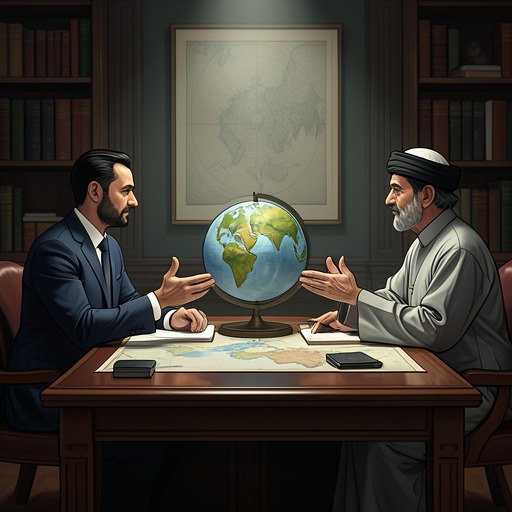
About two centuries after the First World State was formed, its President convenes religious leaders and scientists to formalize their union. At a Pacific island transformed into a many-storied Temple of Peace, Buddhist, Muslim, Hindu, Regenerate Christian, and South American Catholic leaders declare their doctrines different expressions of worship of divine energy. The President then calls for the International College of Science to select a body of scientists to be sanctified by the Church as the Sacred Order of Scientists. Supported at public expense, this order is charged with serving science and investigating the proper worship of Gordelpus, the god of motion. Some scientists are uneasy, but the order is founded and becomes the dominant force in human affairs until the downfall of the first world civilization. The god’s authority is therefore inseparable from institutions that combine religious sanction, scientific prestige, and control of knowledge.
Worship as a Social Discipline
The ideal of progress translates the religion into goals for both individuals and the collective. The First Men are urged toward ever greater aviation, legal sexual freedom, manufacture, and consumption, all coordinated through a more intricate social system. The practical gains of progress have become slight over millennia, but this is treated as evidence that perfection—and the release of the secret of divine power—is near. Religious expectation converts stagnation into a reason to continue striving rather than to reconsider the goal.
From childhood onward, the individual is expected to produce as much motion as possible, through muscular activity or by controlling natural forces. Flying, dancing, and athletics are especially honored occupations, and professional fliers, aeronautical engineers, dancers, and athletes form a privileged class. Flying holds particular prestige because it is useful for communication, represents the swiftest form of travel, and offers a dangerous outlet for adventurousness in a society without warfare. Young people risk their lives in aviation for the glory of Gordelpus, the god of motion, and their own salvation; older people take vicarious satisfaction in their feats. The public spectacle and the religious promise reinforce one another.
The cult of instinct does not mean that conduct is left unregulated. The religion makes the instinct to worship through action supreme, while other impulses are strictly controlled. Sexuality, in particular, is officially obscured by metaphysical interpretations of sacred practices; knowledge and activity are restricted until an individual has won wings, a threshold that could come as early as fifteen or as late as forty. The detail matters to the broader structure of the faith: the state disciplines private life as well as public labor, presenting regulation as part of a divinely ordered hierarchy of activity.
Energy Crisis and Civilizational Failure
The dependence of the First Men on fuel gives the doctrine a material test. After the World State’s foundation, new oil supplies are exhausted in less than three centuries. Aeroplanes are then driven by electricity generated from coal, and the civilization’s energy needs depend heavily on coal, especially the rich fields of Antarctica. Although the fuel is carefully husbanded, the supply is finite. The civilization’s attempts to economize and develop other sources do not prevent its reliance on coal from continuing.
When even the deepest borings in Antarctica yield no further deposits, disbelief gives way to crisis. The practical response would be to end the enormous expenditure on ritual flying, which consumes more communal resources than productive industry. But that remedy threatens both the religion and the flying aristocracy it has elevated. The aristocracy instead demands the release of the secret of divine power and presses the Sacred Order of Scientists to inaugurate a new era. The scientists delay, claiming that the failure of coal is a divinely imposed test and that ritual service should be increased, not reduced. They urge the population to minimize secular uses of power and concentrate on religion, promising that Gordelpus, the god of motion, will permit salvation once human devotion is proven.
The explanation is initially accepted because science retains immense prestige. Ritual flights continue while luxury trades and vital services are cut back, and the remaining power is redirected according to the religious authorities’ priorities. The policy turns a material shortage into a test of faith and blocks the most direct measure for reducing consumption. The civilization’s failure is consequently not just the exhaustion of its coal: its institutions cannot abandon a sacred practice even when that practice consumes the resources required for survival. Gordelpus, the god of motion, embodies the First Men’s aspiration to transform activity into permanence, but the story’s irony is that the worship of ceaseless motion helps bring their civilization to an end.